

- a marginal — how likely a fact is, overall;
- a conditional — how likely a fact is, given what you observed.
Smallest runnable example
The classic wet-grass model: rain and the sprinkler each make the grass wet, you observe that the grass is wet, and you ask how likely each cause was.xlog prob. xlog run is the deterministic
runner — it will not produce a probability. The exact engine is the default, so
--prob-engine exact_ddnnf is optional.
What you should see. Because the grass is wet, both causes come back more
likely than their starting probabilities (0.7 and 0.2), and rain() — the
stronger prior — carries most of the posterior mass.
When to use each engine
Reach for the exact engine when you need the true answer and your program is small — for example when it uses negation, recursion, or small aggregates. Reach for the Monte Carlo engine when the model is larger, or uses a feature the exact engine does not support, and a sampled estimate with error bars is good enough.Writing a probabilistic program
A probabilistic fact is a fact prefixed with a probability and::. It holds
with that probability and fails otherwise:
;, each with its own probability. Exactly one outcome is chosen. If
the probabilities sum to less than 1, the remaining mass is an implicit “none”
outcome:
evidence(...) and ask for a probability with
query(...):
use. Pass --module-path
so xlog prob can find those modules:
Select the engine with
#pragma prob_engine = exact_ddnnf or
#pragma prob_engine = mc, declared
in the entry file — a pragma in an imported module is ignored and reported as
warning[W0510] (see the
pragmas guide). From Python, the prob_engine argument to
Program.compile(...) takes precedence over the pragma.Exact inference
The exact engine (exact_ddnnf) computes the true probability by turning your
program into a circuit and then adding up the probability of every world in which
the query holds. Turning a program into a circuit like this is called knowledge
compilation; adding up those world probabilities is weighted model counting.
The data plane runs on the GPU, while compilation and level-by-level evaluation are
host-orchestrated:
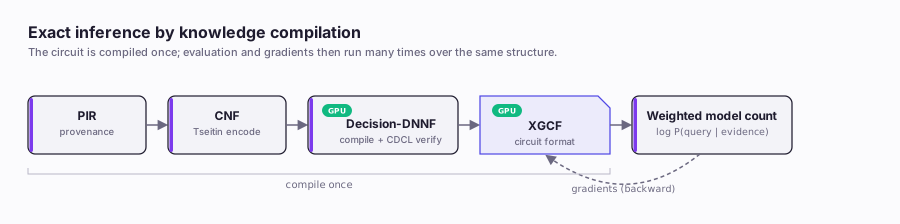
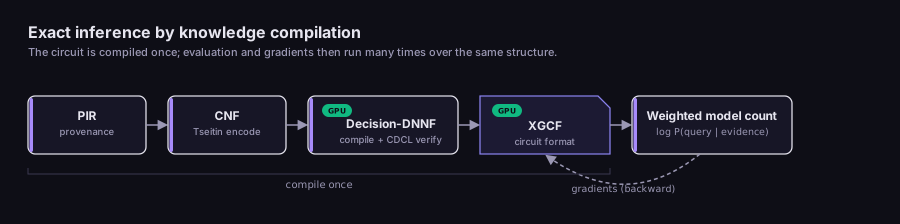
The exact path compiles provenance to CNF, then to a verified GPU Decision-DNNF, then to the XGCF circuit; the circuit is compiled once and evaluated many times, with gradients flowing back through it.
1
Provenance
Rule evaluation records, for every derived tuple, which probabilistic choices
support it. This record — a graph over the probabilistic facts and annotated
disjunctions — is called the tuple’s provenance.
2
CNF
The provenance graph is encoded into a Boolean formula in the standard
AND-of-ORs form (
CNF, conjunctive normal form), with a variable map that
lives on the device.3
Decision-DNNF
A GPU compiler turns the
CNF into a Decision-DNNF circuit — a circuit form
whose worlds can be counted exactly in a single pass. XLOG smooths the circuit,
then certifies that final smoothed circuit before caching or evaluating it. A GPU
SAT solver (using CDCL, the standard conflict-driven clause-learning algorithm)
checks logical equivalence to the formula; bounded status and error scalars are
observed on the host, while the proof trace is checked on the GPU.4
Weighted model counting
The verified circuit — XLOG’s GPU circuit format,
XGCF — is evaluated in
log-space to produce log P(Q and E) and log P(E). Their difference is the
conditional probability log P(Q | E).Reading the exact result from Python
From Python,result = program.evaluate() carries the same two quantities the
circuit produced:
result.log_z_eis the exact log-evidence — thelog P(E)above, as a natural log. It isNonefor Monte Carlo results.program.prob_var_map()says what each position inresult.grad_true/result.grad_falsestands for:{"kind": "fact", ...}for a probabilistic fact,{"kind": "choice", ...}for one branch of an annotated disjunction, or{"kind": "other"}for a variable that is not a source of randomness. That is how you attribute a gradient back to the fact that produced it. Those two vectors are filled in only byprogram.evaluate(return_grads=True); the plainevaluate()above leaves bothNone.
prob_var_map() is exact-engine only. It raises ValueError for Monte Carlo
programs, and also for exact programs compiled through the GPU count-lift fast path,
which never builds the encoding the map describes. See the
Python reference for the full field list.
Gradients flow back through the same circuit, so a probabilistic program stays
differentiable end to end and can sit inside a training loop. This works through
negation too: a negated literal contributes with the correct sign flip.
Conditioning on accepted epistemic evidence
Rust integrations can condition exact inference on a world view accepted by the epistemic GPU runtime.EpistemicProbProductionAdapter validates the runtime
provider identity, the typed execution_backend = gpu and
fallback_policy = reject_unsupported policy, semantic trace, tuple-membership
evidence, and final tuple materialization before it passes that evidence to the
exact source or parsed-program path. Eligibility also requires positive observations
from the executed route: recorded CUDA-event timing, GPU kernel and dispatch counts,
device-backed final output, and transfer accounting. The same accepted-evidence
boundary covers PIR and CNF encoding, knowledge compilation, query evaluation, and
gradients. The bounded EpistemicCircuit test fixture is excluded from
production-path metrics.
Methods with conditioned in their name translate accepted assumptions into
probabilistic evidence(...) clauses, so they can change the returned probabilities;
the other accepted-evidence methods use the world view as an admission gate without
modifying the probabilistic model.
This accepted-world-view axis is available for direct and split-batch GPU execution
evidence. It covers caller-owned incremental circuits, source and parsed-program
compilation, conditioned and unconditioned evaluation, gradient evaluation, and PIR/CNF
encoding. Every entry point passes through the same evidence validation and transactional
trace accounting; batch methods apply that contract independently to each accepted world
view rather than bypassing it through a separate implementation.
The policy-key migration also changes every epistemic plan_id: the identifier is
the hash of the canonical plan summary, so removing the old fallback keys and adding
the typed policy keys deliberately invalidates identifiers generated by earlier
versions. Consumers must regenerate plan-id goldens, caches, and evidence-ledger
references rather than treating old and new identifiers as interchangeable.
production_capabilities() is a static inventory of backend stages implemented by
the adapter. It is not a CUDA probe, a Cargo-feature report, or a claim that every
epistemic planner returns compatible evidence. The typed policy rejects unsupported
shapes instead of reporting a default-zero fallback counter; production eligibility
still depends on the observed GPU evidence above. This contract does not claim zero
host traffic, because concrete tuple evidence is read from accepted output columns
after the certified hot path.
The public Rust capability report replaces
GpuSolverProductionCapabilities::cpu_oracle_solver_allowed with the exhaustive
production_metric_backend policy. Consumers must match its current
GpuSolverProductionMetricBackend::GpuOnly variant instead of treating a constant
boolean as evidence that CPU solving was excluded. The production metric gate still
requires positive accepted-candidate and GPU solver event evidence from the executed
route.
The public Rust EpistemicGpuSemanticTrace and specialized epistemic runtime JSON
no longer include rejection_reason_device_reads. Rust callers and fixed-schema
JSON consumers must remove that field or key and use
rejection_reason_metadata_bytes for the bounded rejection-reason payload. The
retained byte count is derived from the length of the rejection-reason vector
returned by the device read and must match one u32 reason slot per generated
candidate. The separate bounded read of constraint-violation indices remains part
of the runtime boundary but is not folded into this rejection-reason-specific byte
count.
This handoff consumes EpistemicGpuExecutionResult records produced by the
single-pass Generate-Propagate-Test route, including split batches. Recursive
epistemic programs take a different route: the high-level LogicProgram evaluator
runs the applicable founded, Gelfond-1991 compatibility, or well-founded fixpoint
and returns a LogicEvalResult containing relation results. That result type is not
an input to EpistemicProbProductionAdapter, so backend availability does not claim
recursive-world-view conditioning. A recursive source must use the high-level
evaluator; it cannot be sent to compile_epistemic_gpu_execution, whose contract is
intentionally limited to acyclic single-pass programs.
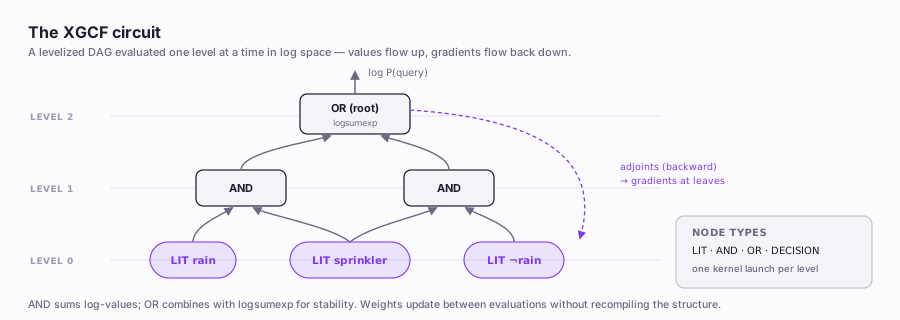
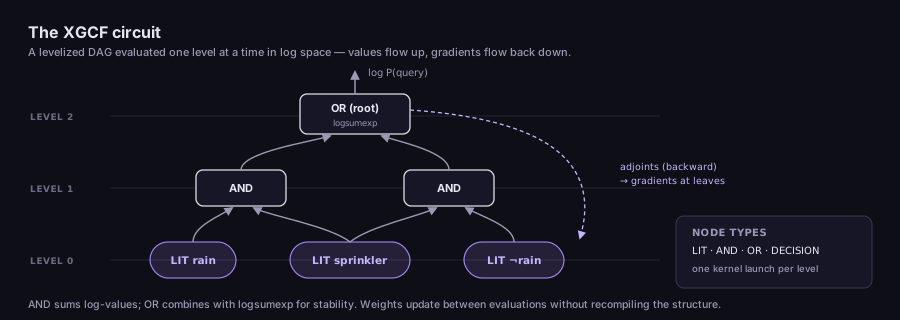
The XGCF circuit is a levelized DAG: literal leaves feed AND and OR nodes evaluated one level per kernel launch in log space, and adjoints propagate back down to produce gradients at the leaves.
Aggregates in exact inference
The exact engine can push aggregates through uncertainty, up to fixed bounds:- For
sum,min,max, andlogsumexp, it enumerates the outcomes of up to16uncertain rows per group exactly. - For
count, a dedicated count-lifting path handles up to64uncertain rows per group.
#pragma prob_engine = mc
for that program.
Monte Carlo inference
The Monte Carlo engine (mc) estimates probabilities by sampling many possible
worlds and counting how often the query holds.
Its production path is a megakernel — a single GPU kernel that evaluates every
sampled world in one launch, followed by one synchronization. Observations are
handled by rejection sampling: only sampled worlds that satisfy evidence(...)
are counted; the rest are thrown away.
Each query reports an estimate prob (with log_prob), a standard error
stderr, a two-sided confidence interval (ci_low, ci_high), the sample counts,
and the seed. The confidence interval is how you tell whether you drew enough
samples: if it is too wide for your needs, draw more.
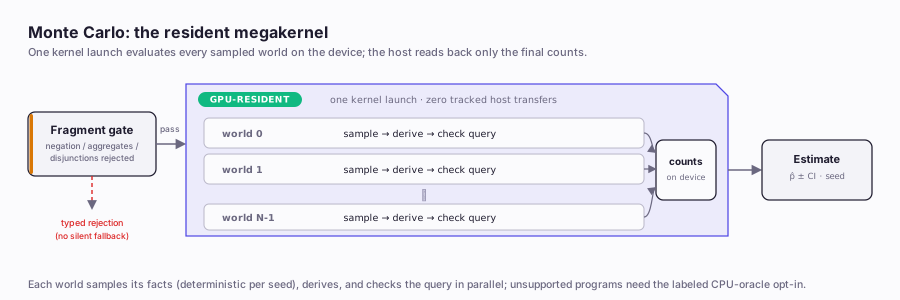
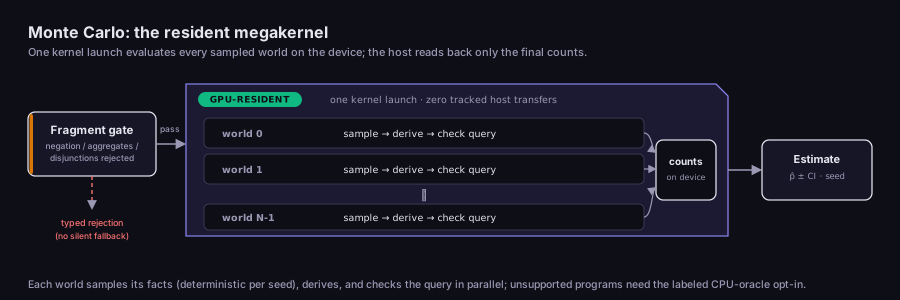
One kernel launch evaluates every sampled world in parallel on the device; counts stay device-resident, and the host reads back only the final estimate.
Limits of the Monte Carlo engine
The megakernel sizes its GPU memory once, up front, before it allocates anything. For that to be possible, a program is accepted only when it stays within these bounds:
Exceeding a structural, domain, sample, or other fixed-count capacity stops with
CapacityExceeded, including the name of the exhausted unit. Exceeding the configured
byte budget stops with ResourceExhausted before the failing allocation. Reaching a
bounded fixpoint’s iteration limit without convergence stops with
ConvergenceFailure. These conditions are distinct so callers do not mistake a count
limit or nonconvergence for VRAM exhaustion. There is no larger host-sized execution
path.
The engine also rejects — with a typed error — any program that uses negation,
aggregates, or annotated disjunctions. In every one of these cases it refuses
cleanly rather than guessing (it “fails closed”).
Diagnostics and guarantees
This section is for readers who need to reason about where computation runs and what the engines promise. You do not need it to write a probabilistic program. Monte Carlo — certified sampled core. For the sampled region, the megakernel keeps all work on the GPU. It performs0 tracked host-to-device transfers, 0 tracked
device-to-host transfers, and 0 untracked metadata reads. This holds constant
whether you draw 128 samples or 1024. After the single launch and synchronization,
one pinned terminal receipt transfers authoritative convergence status, counts, and
trace metadata. A nonconverged receipt is an error even if partial counters exist.
Exact engine — GPU-accelerated, host-orchestrated. The exact engine runs on
the GPU but is driven from a host loop: the forward evaluation launches one kernel
per circuit level. No per-level data is read back — the circuit and its intermediate
values stay on the device. Device-result APIs retain requested result and gradient
buffers on the GPU; host-convenience APIs copy the result fields the caller requests.
The exact route also observes bounded solver status and error scalars. It therefore
does not offer the single-launch sampled-core guarantee of the Monte Carlo engine.
No CPU Decision-DNNF compiler. Production exact inference is always the GPU
compiler and verifier described above. XLOG never bundles a CPU d-DNNF compiler and
never shells out to an external d4 binary. Decision-DNNF parsing exists only for
tests and fixtures.
Rule learning
The exact engine’s differentiable circuits are the same infrastructure that
trains neural predicates and learned rules end to end with PyTorch.