

know
and possible, and XLOG answers them on the GPU.
Use it when a plain fact is not enough and you need to distinguish a settled
conclusion from an open one — for example, “treat someone as safe only if their
vaccination is confirmed no matter how the facts shake out,” versus “it is at
least possible they are vaccinated.”
When to use this
Reach for epistemic reasoning when your program has more than one self-consistent solution and you care about that spread. A stable model is one such solution: an assignment of facts that justifies exactly itself and nothing more. A program can have many. Ordinary Datalog picks a single model and stops; an epistemic program instead reasons over the whole set of models it considers possible at once — its world view — and lets you ask what holds across that set.know p— isptrue in every possible world? (a settled conclusion)possible p— isptrue in at least one possible world? (an open one)
Smallest runnable example
Only Alice is on record as vaccinated, so she is the only person whoseknow vaccinated can hold across every world. Save this as safe.xlog:
alice alone. bob is a person, but
nothing makes his vaccination status known, so know vaccinated(bob) fails and
he is not derived as safe. That single-row answer is how you confirm the modal
rule fired: getting alice alone — rather than every person, the way plain
Datalog would with no vaccination guard — is your signal that the know operator
is doing the work.
Modal operators
You write a modal literal by prefixing a body atom withknow or possible, and
you can negate either one. Over a world view — a non-empty set of accepted stable
models — the operators mean:
The key distinction is that
possible p and not know p can both be true of the
same atom at the same time. That is exactly how you express genuine uncertainty
about what the program commits to.
Nested operators
You may nest operators into finite chains, such asknow possible p. XLOG
collapses each chain to a single operator before running it, using the standard
logical equivalences for nesting (parity and duality).
For example, know possible p reduces to possible p, and know possible not p
reduces to not know p.
Ruling out worlds
A headless rule that starts with:- is a constraint. It throws away any world
view in which its body holds. Add these lines to safe.xlog:
quarantined() is a plain fact, so
know quarantined() holds in the one world view the program admits, and the
constraint discards it. Pruning every candidate is a semantic result — an empty
answer — not a runtime failure.
Limits. A constraint body must be know/possible literals only; mixing in an
ordinary or comparison literal, as in :- p(X), know q(X)., is rejected. Each
variable may appear in exactly one modal literal, and only once inside it — so
:- know p(X). is fine, but :- know p(X), possible q(X). and :- know p(X, X).
are not. Key positions take ground integers or symbols, or a single-occurrence
variable or _; lists, compound terms, floats and strings are refused. Finally, the
program needs at least one know/possible rule for the constraint to be checked
against — a constraint on its own has no world view to prune.
World-view semantics
An epistemic program is evaluated against its world view rather than a single model. Consider this rule:vaccinated(P) is settled across every world
the program admits — that is knowledge, not mere possibility. Swapping know for
possible weakens the requirement to holding in at least one world.
Choosing a semantics: faeel vs g91
Two semantics decide when a know or possible fact counts. You pick one with a
pragma, declared in your entry file — a #pragma epistemic_mode in an imported
module is ignored and reported as warning[W0510] (see the
pragmas guide):
faeel is the founded semantics and the default. Founded means a fact
counts only if the program actually derives it, not if it merely asserts itself.
Under faeel, both know p and possible p demand that p be founded, so a
purely self-supporting rule like p() :- possible p(). collapses to the empty
founded extension — nothing is concluded. Modal tuple transitions participate in
the same least fixpoint: a transition from an independently founded predecessor can
derive new tuples, while an unseeded cycle between tuples remains empty.
g91 selects Gelfond-1991 semantics, the classical 1991 definition, under
which that same self-support is accepted. For a supported positive
exact-tuple possible cycle, compatibility is checked per concrete tuple. XLOG
starts from an upper bound and repeatedly filters it against the preceding
iteration’s relation snapshots. A mutual predicate cycle therefore preserves a
tuple only when the rules can support that same tuple around the cycle; two
rules ranging over disjoint domains do not support one another merely because
their predicate names are recursive.
Choose faeel when you want knowledge grounded in derivation. Choose g91 for
classical Gelfond-1991 compatibility.
How it runs
XLOG first compiles your program into an epistemic IR — an internal form built specifically for modal reasoning. Accepted programs always go through this form; a bare modal lowering that skips it is rejected. For acyclic modal programs, XLOG then runs Generate-Propagate-Test on the GPU: it enumerates candidate world views, prunes the inconsistent ones, and tests the rest. Ordinary or modal dependency cycles are classified before that single-pass boundary. Positive modal cycles underfaeel use an ordinary founded reduction and
run to their least fixpoint. Supported exact-tuple possible cycles under g91 run
a GPU upper-bound pass followed by descending frozen-snapshot refinements to the
greatest compatible tuple fixpoint. Cycles that also involve negation run on the
well-founded plan — an evaluation that assigns each fact true, false, or
undefined instead of forcing a choice — computed on the GPU.
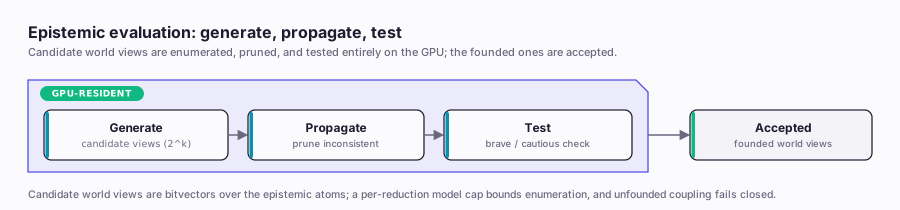

For acyclic modal programs, Generate-Propagate-Test runs on the GPU: candidate world views are enumerated, pruned to the consistent ones, and tested under the selected semantics.
1
Generate
Candidate world views are enumerated from the program’s epistemic literals.
2
Propagate
Immediate known-or-rejected contradictions are pruned before any candidate is tested.
3
Test
Each surviving candidate is evaluated under the selected semantics, and valid
world views are accepted.
Keeping the search tractable
To avoid enumerating more than it has to, XLOG uses epistemic splitting: it breaks the program into independent pieces and solves each on its own. Rules that genuinely couple more than one modal predicate cannot be split. XLOG unions those into a single piece and solves them jointly, as one modal conjunction over the candidate world view. It then restores the original rule order once the pieces are recombined. One shape it cannot solve jointly: two epistemic heads in the same piece where one head’sknow/possible literal ranges over the other epistemic head. The truth
of that inner modal literal depends on a world view that is itself still being
decided, so XLOG rejects the program rather than guess. Break the two heads apart —
have the inner one range over a plain relation instead of an epistemic-derived one.
Limits
For a program that reaches the Generate-Propagate-Test path, the number of candidate world views is2^(number of epistemic literals) — one candidate per
truth assignment to the program’s epistemic literals. Every extra epistemic
literal doubles this search. This doubling applies only to the single-pass path.
Programs whose modal predicates depend on each other in a cycle take a different
route — a repeated-derivation fixpoint — and never enumerate candidate world views
at all.
A single Generate-Propagate-Test reduction produces at most 1024 models. Nothing
you can pass to xlog run changes that number.
Positive modal dependency cycles are not blanket rejection cases: faeel evaluates
them through a founded least fixpoint, and supported exact-tuple possible cycles
under g91 use the greatest compatibility fixpoint. The number of compatibility
refinements is bounded by #pragma max_recursion_depth. An unrelated negative cycle
can execute through the well-founded plan inside those passes. Recursive negation or
aggregation inside the compatibility cycle itself is rejected: the refinement only
ever removes tuples, and negation and aggregation can make a predicate grow when
their inputs shrink.
Some shapes have no supported route at all. XLOG rejects those at compile time with
an UnsupportedEpistemicConstruct error naming the construct — it never silently
mis-evaluates them. The ones you are most likely to write:
The first one catches most people. This page’s own rule is fine on its own:
safe(P) :- staff(P). — is rejected
at compile time, unless the modal filters are provably redundant across the clauses.
For the complete enumeration of these rejections, with the exact construct string
each one reports, see
Epistemic rejections. The same boundaries
are stated as language rules under
Epistemic support and boundaries.
Reference
How XLOG works
Epistemic reasoning reuses the same parser, type checking and CUDA runtime as any
other XLOG program; only the execution plan is chosen differently — see how a
program travels from source to GPU.