

When this matters
Read this page when you want a correct mental model of what happens after you write a program: how it is compiled, why all four user-facing paradigms share one frontend, and why the output is cheap to hand to a tensor framework. You do not need it to write your first program. You do need it to reason about performance, or to understand why XLOG fits inside a training loop rather than beside it. This is a conceptual explainer, not a task walkthrough: it builds a mental model of the compilation path rather than stepping you through a runnable program. For a hands-on start with real output, see the quickstart.The pipeline
Every program shares frontend parsing, normalization, type checking, and dependency analysis. The host machine then compiles and orchestrates the appropriate backend path. The GPU holds the data and runs the actual computation as CUDA kernels. The diagram below follows the deterministic relational path. Other reasoning styles branch from the normalized frontend into their own intermediate forms, as shown later.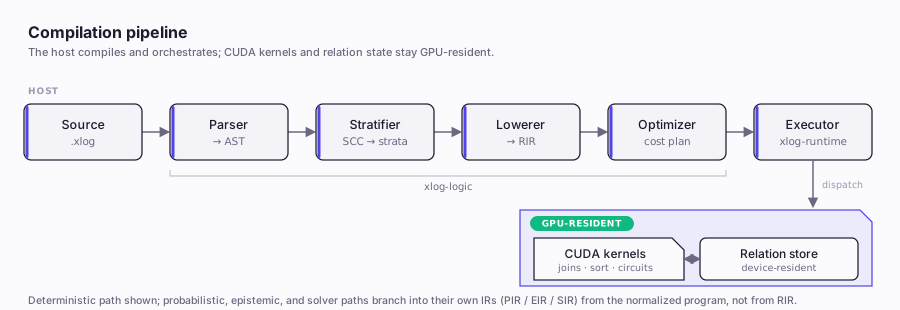
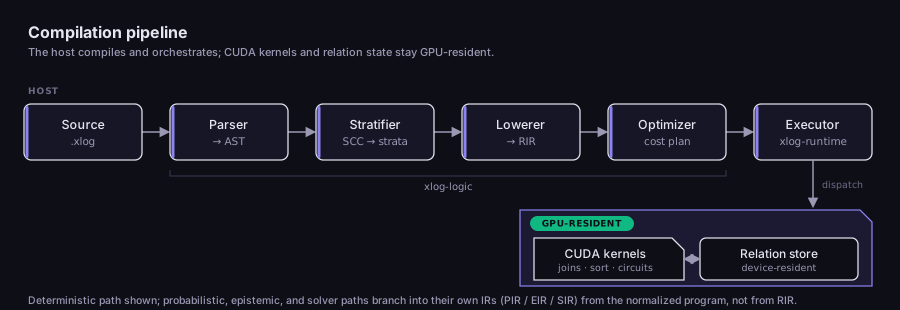
A deterministic program is parsed, stratified, lowered to relational IR, optimized, and executed by dispatching CUDA kernels over device-resident relations.
1
Parse
A PEG grammar (a formal grammar that tries its alternatives in a fixed order, so
every input has one unambiguous parse) turns your program into an abstract syntax
tree (a structured tree form of your program that the compiler works on).The grammar is the definitive surface of the language: if a construct does not
appear in it, it does not parse.
2
Stratify
For the deterministic relational path, XLOG splits the program into ordered layers,
called strata, so that negation and aggregation are computed in a safe order.It does this by finding cycles in the predicate dependency graph
(strongly-connected-component analysis). If a use of negation or aggregation cannot
be placed in such an order, XLOG rejects the program.
3
Lower
The stratified deterministic program is rewritten into a relational intermediate
representation (
RIR) — your program expressed as database-style operations.Those operations are joins, filters, projections, aggregations, and recursive loops
(fixpoints).4
Optimize
Lowering chooses a deterministic greedy join order, and the optimizer pushes
filters closer to the data so less work reaches later stages. Shape-specific
selectivity rewrites improve recognized triangle and four-cycle plans; a general
dynamic-programming join optimizer is not active.It also promotes eligible joins to worst-case-optimal multiway joins — a join
method that computes multi-way patterns, such as triangles in a graph, directly
instead of building a large intermediate table.
5
Execute
The ordinary executor orchestrates the plan on the host and dispatches CUDA kernels
over relations in GPU memory. Eligible recursive query plans are selected
automatically for a certified resident conditional-graph route; that route runs
its bounded fixpoint inside one recorded launch and returns one final control
receipt after synchronization.Deterministic recursion runs as a semi-naive fixpoint: a loop that repeats a rule
until nothing new is derived, processing only the newly-found facts on each round.
Four paradigms, shared backend routes
XLOG presents four user-facing paradigms — deterministic, probabilistic, epistemic, and neural-symbolic — and all four share parsing, normalization, type checking, and dependency analysis. They do not map one-to-one to intermediate representations. The normalized program fans into three reasoning IR routes: deterministicRIR,
probabilistic PIR, and epistemic EIR. Neural-symbolic training composes neural
predicates with the relevant reasoning route instead of introducing a separate IR.
SAT/MaxSAT features and verification use the shared GPU-resident GpuCnf and CDCL
solver service rather than another IR.
Each reasoning branch is built from the normalized program — the parsed and analyzed
rules put into a common standard form — not from the deterministic RIR. The
probabilistic and epistemic routes are therefore siblings of the deterministic route,
not layers on top of it. The solver service consumes GPU-resident CNF supplied by
features that need verification or SAT/MaxSAT search.
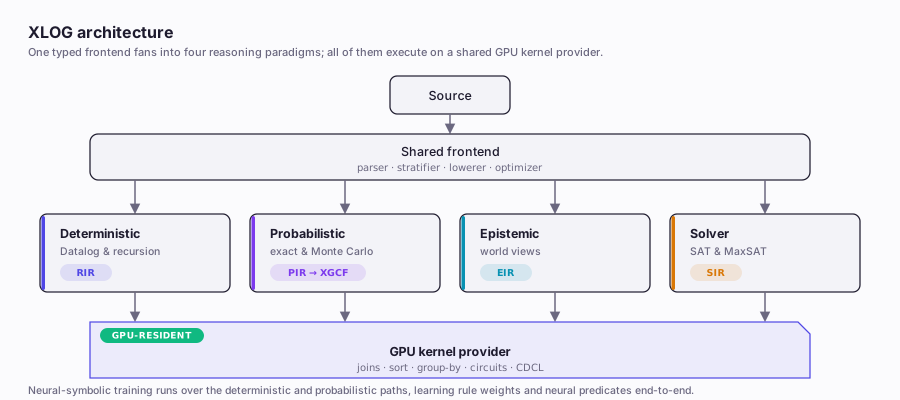
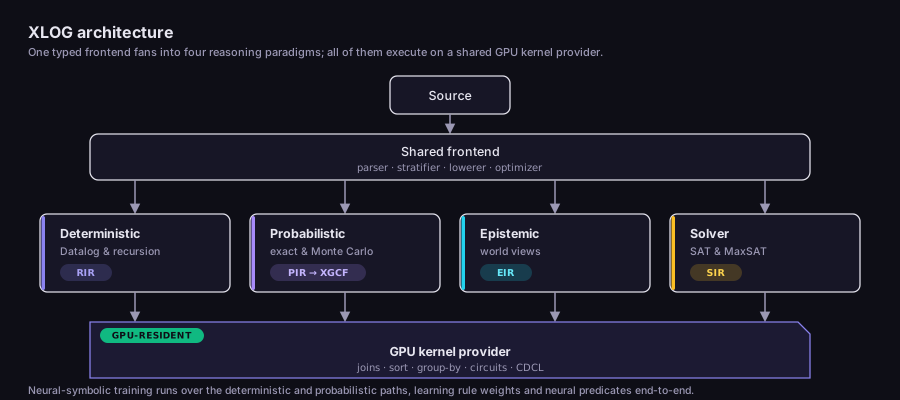
One typed frontend fans into three reasoning IR routes plus a shared GPU CNF/CDCL solver service.
- Least-model semantics — the unique smallest set of facts that the rules force to be true.
- Exact knowledge compilation — turning the program into a circuit that computes exact probabilities, rather than estimating them by sampling.
- World-view semantics — reasoning about what an agent knows (
know) or considers possible (possible); a world view is the set of models the program treats as possible at once.
How the paradigms map to intermediate forms
The pieces above become concrete once you see how each path is represented internally. The normalized AST is the shared source for each reasoning IR; the probabilistic and epistemic paths do not branch from deterministic RIR. RIR represents deterministic relational execution. PIR represents probabilistic execution and compiles into the GPU-evaluable circuit format calledXGCF. EIR
preserves modal meaning while the high-level dispatcher classifies dependencies.
Neural-symbolic training supplies neural predicate values to, and consumes
differentiable results from, these symbolic routes rather than using a fourth
reasoning IR. SAT/MaxSAT and verification features submit GPU-resident GpuCnf
inputs to the shared CDCL solver service.
Inside the epistemic route, one more choice is made for you. XLOG looks at the shape
of the program’s dependencies — whether the modal rules form a cycle, and what kind —
and picks how to evaluate it:
faeel and g91 are the two epistemic semantics you choose between with
#pragma epistemic_mode; the epistemic overview explains what
each one accepts and when to pick it.
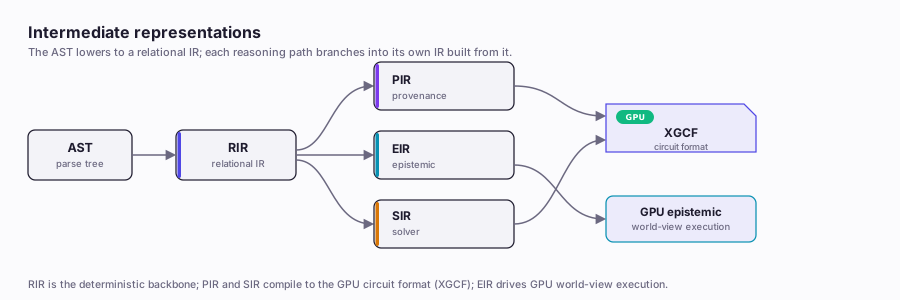
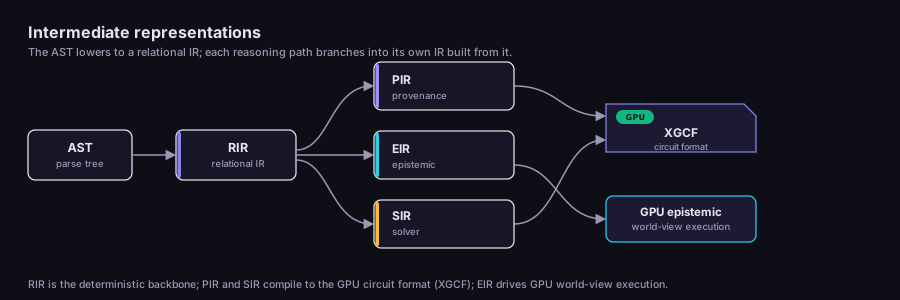
The normalized AST fans into RIR, PIR, and EIR. SAT/MaxSAT and verification use a separate shared GpuCnf/CDCL service.
Internal names, in one place. These abbreviations name the intermediate forms a
program passes through. You do not write them, but you will see them in diagnostics
and diagrams.
RIR— relational IR: your program as joins, filters, projections, aggregations, and fixpoints.PIR— probabilistic IR; tracks which facts and probabilities contributed to each result (its provenance), and compiles toXGCF.EIR— epistemic IR; preserves modal semantics and drives execution-route classification.GpuCnf— the GPU-resident CNF representation consumed by the shared CDCL solver service.XGCF— the GPU-evaluable circuit format produced by probabilistic knowledge compilation.
Compile once, evaluate many
The compiled plan is structure, and that structure is stable. Across training iterations or repeated queries, only the data and the weights change; the plan itself does not. So XLOG compiles a program once and reuses the plan on every evaluation. For probabilistic inference it also reuses the compiled circuit. This is what makes XLOG usable inside a training loop rather than alongside it.Device result handoff
Query-output and gradient buffers remain on the GPU when handed to tensor code. XLOG exposes them through DLPack capsules and Arrow — two standard formats for sharing tensors and tables between GPU libraries without copying the data plane through host memory. Because of that, a downstream tensor computation in PyTorch, JAX, or cuDF reads those device buffers directly. Host-orchestrated routes may still observe bounded status or metadata, so a final tensor’s device location is not by itself evidence that the entire preceding execution had zero transfers.Why GPU residency matters
The defining constraint behind XLOG’s design — and what separates it from CPU logic
engines bolted onto a GPU tensor framework.