

A recursive rule
The classic example is transitive closure. Start with a one-stepedge relation and
derive the many-step reach relation:
reach with every direct edge. The second rule is recursive: it
mentions reach in its own body, saying “if there is an edge from X to Y, and Y
already reaches Z, then X reaches Z.” Applied over and over, these two rules
compute every path in the graph.
Semi-naive fixpoint evaluation
XLOG does not re-derive everything on every round. It groups mutually recursive predicates into strongly-connected components — the cycles in the rule dependency graph — and evaluates each component with a semi-naive fixpoint.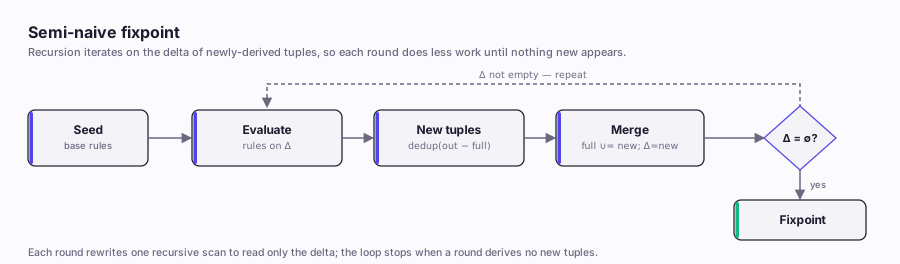
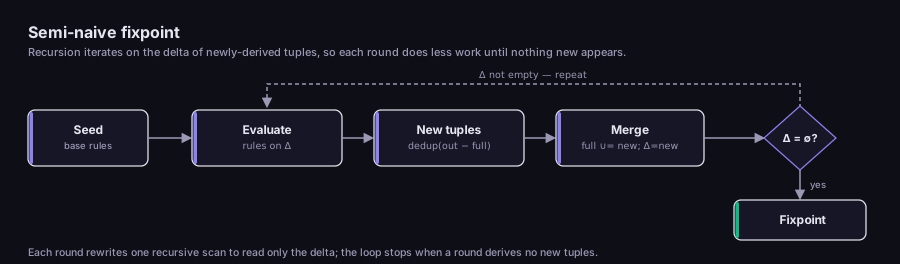
Semi-naive evaluation: each round joins only the delta of newly-derived tuples, merges what is new, and stops when a round produces nothing.
Semi-naive evaluation is what makes recursion practical on a GPU. Instead of recomputing
the whole relation every round, each round is a join against a shrinking delta — the same
hash joins you already use for non-recursive rules, run to a fixpoint.
Termination
Evaluation of a recursive component halts when a round derives no new tuples — the delta is empty, the relation has stopped growing, and the fixpoint is reached. Because every derived tuple is built from a finite domain of values already present in the program, the relation cannot grow forever, and evaluation always terminates on well-formed input. As a safety bound against a runaway or accidentally explosive program, XLOG caps the number of recursive rounds with a pragma:1000. If a recursive component has not reached its fixpoint within this
many rounds, evaluation stops rather than looping indefinitely. Raise it for genuinely
deep recursion; the bound exists to fail loudly, not to shape your answer.
Recursion must be stratified
Recursion may flow through positive atoms freely, but it may not flow through negation or aggregation. A predicate cannot depend — even transitively — on the negation of itself, and it cannot recurse through an aggregate over itself. Such a program has no well-defined fixpoint, and XLOG rejects it at compile time with a stratification error. The fix is to forward-link: compute the recursive relation to its fixpoint first, then negate or aggregate over the finished result in a later, non-recursive rule. Because the recursion sits in an earlier stratum, its answer is fully settled before the negation or aggregation ever runs.Negation
How stratified negation-as-failure works, why it must be stratifiable, and the binding
rules that keep negated atoms safe.