

For contributors — this page explains how factorized execution works
internally. It is not a user setup guide. If you want to use these routes —
turn one on, tell whether it fired, or force it off for a comparison — read
WCOJ tuning instead. That is the user-facing home for
this feature; it covers the same routes, kill switches, and dispatch counters
from the caller’s side.
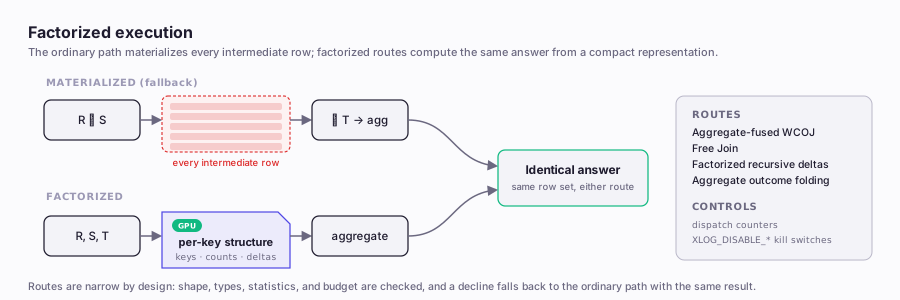
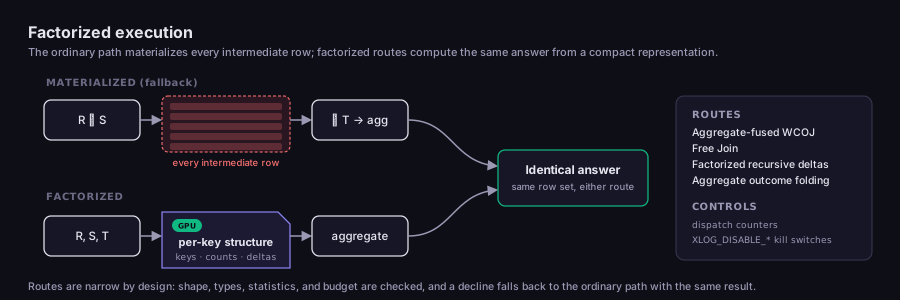
Both routes return the identical row set: the ordinary path materializes every intermediate row, while a factorized route computes the answer from a compact per-key structure — gated by dispatch counters and kill switches (environment variables that force a route off).
The routes
Factorized execution covers five routes. Each one avoids a specific kind of intermediate blow-up, and each exposes a dispatch counter — a runtime tally you read to confirm the route actually fired. A few terms used below:- WCOJ — worst-case-optimal join, a join algorithm for multiway patterns (triangles, cycles, cliques) that keeps peak memory flat instead of building a large intermediate.
- Free Join — a generalized multiway join route for bodies that do not match a dedicated WCOJ shape.
- count-by-root — counting grouped results by their group key without first expanding the private trailing variables that are only there to be counted.
- recursive delta — the newly-derived tuples added on each round of a recursive rule (for example, transitive closure).
Two terms in that table: a witness is one specific derivation (one way a fact
was proved), so “witness-multiplied” means the delta join produces a row per
witness. An outcome mask is one possible truth assignment over the uncertain
facts in a probabilistic program.
When routes fire
Factorized routes are deliberately narrow. A route checks rule shape, key width, variable layout, aggregate operator, relation statistics, domain size, memory budget, and kill switches (environment variables that force a route off) before it accepts a query. If a route declines, the runtime uses the ordinary path when a fallback is defined. A decline is not a correctness failure. It is the mechanism that keeps an unsupported shape from pretending it used a specialized engine. The answer is the same either way; only the execution strategy differs.Confirming which route ran
Read the dispatch counters instead of guessing from timing. Query them from the session or executor that ran the workload:Kill switches
A kill switch is an environment variable that forces a route off, so you can run the ordinary fallback path for a side-by-side comparison. Set any of these to1:
XLOG_DISABLE_WCOJ_GROUPBY_FUSION=1XLOG_DISABLE_FREE_JOIN=1XLOG_DISABLE_FACTORIZED_DELTA=1
- the optimized route fired when enabled (its dispatch counter is
> 0); - the fallback produced the same row set when the route is disabled.
Aggregate-fused WCOJ
This route computes selected grouped aggregates directly over the WCOJ shape. It reduces by the group root (the group key it aggregates by) without first producing the full join output. Supported shapes and widths are implementation-defined. An unsupported aggregate operator, key width, or group key declines to the existing materialize-plus- groupby route, or returns the same error that the fallback would return.Free Join
Free Join is the generalized multiway route. It handles eligible bodies with three or more atoms that do not use a dedicated triangle, 4-cycle, or clique kernel. The planner has three options for such a body. It can keep the source order, choose a better prefix-key-compatible order, or decline to the binary-join fallback. Dedicated WCOJ shapes stay on their dedicated kernels.Factorized recursive deltas
This route targets transitive-closure-shaped rules — recursive rules that keep adding reachable pairs until nothing new appears. Instead of materializing every witness pair and then subtracting the tuples it already knows, the route computes the novel set directly, grouped by root. The route picks its data structure by domain density. A dense domain uses a bitvector route. A large sparse domain uses a hash-set route. A shape outside the supported rule family falls back to the ordinary recursive path.Verifying a route in practice
To demonstrate that a route did what it claims, pin down all four of these:- the program shape that should trigger the route;
- the route expected to fire;
- the dispatch counter that proves it fired;
- the kill-switch parity check (route on vs. route off, same row set).